
The Rise of Career-Connected Learning

The Success Story You Haven’t Heard Enough About

There is a quiet revolution happening in New Orleans public schools, and it is changing the trajectory of our students’ lives. It’s called Career-Connected Learning.

At its core, Career-Connected Learning links education with real-world career experiences. For those of us in earlier generations, “VoTech” or “Shop” may come to mind, but today’s version is vastly different. It serves as a vital bridge between high school and what comes next—whether that is college, a career, or a combination of both.

Powered by a robust ecosystem of schools, families, employers, and training providers, YouthForce NOLA has led a citywide effort to establish this approach as a core pillar of the city’s education and workforce strategy. Career-Connected Learning focuses on a “trifecta” for student success: Industry-Recognized Credentials, Soft Skills, and Work-Based Learning.

Technical Skills: Earning Credentials of Value

A key focus is providing interested students the opportunity to earn Industry-recognized credentials in high wage, high demand career pathways. Credentials validate that a student has mastered technical skills that employers value, helping to bridge the gap between the classroom and the workforce.

The growth in credentials has been explosive. In 2014, fewer than 50 graduating seniors held an industry credential. Last year, the graduating class of 2025 earned over 1,100 credentials.

A major driver of this success is the New Orleans Career Center (NOCC). In March 2023, NOCC opened a state-of-the-art facility at the former McDonogh 35 site (after having operated in various sites since their first cohort in fall 2018). Students spend half their day at their home high school and half at NOCC, training in high-demand fields and earning credentials and pre-apprenticeships in areas like nursing, medical assistant, certified nurse assistant, HVAC, carpentry, electrical, culinary arts, and engineering. In 2017, NOCC began with 129 trainees from 7 high schools. Today, it is training 670 students from 23 high schools.

“I now see a future I didn’t believe was possible.”

– Paul J., Sophie B. Wright Senior and NOCC Student

Soft Skills: The “Secret Sauce”

Technical skills get you the interview, but soft skills get you – and keep you on – the job. Often called “employability skills,” these transferable traits increasingly rank above technical training for entry-level applicants. In an age of AI and automation, the human element—collaboration and adaptability—is more valuable than ever. Top executives recognize the growing importance of these skills in the face of job losses tied to AI.

“My advice to people would be critical thinking, learn skills, learn your EQ [emotional quotient], learn how to be good in a meeting, how to communicate, how to write.”

– Jamie Dimon, JP Morgan Chase CEO

Through federal grants and City support, YouthForce NOLA and providers like NOCC and Operation Spark are integrating these six core skills directly into technical training and classrooms:

As a bonus, NOLA-PS school leaders are increasingly adopting soft skills programming in general subject areas—and seeing improvements in student attendance, academic engagement, and test scores.

Work-Based Learning: Bridging Skills to the Workplace

Everyone has to have their first job at some point, but few employers want to be anyone’s first full-time job. Paid internship programs fill in this void – creating a structured on-ramp to work for young people while also supporting employers as supervisors.

YouthForce NOLA’s paid summer internship program is a cornerstone of this citywide effort. The experience begins with 60 hours of intensive training in soft skills and business etiquette, followed by 110 hours of work experience. This is the critical step where young people practice and internalize their technical skills and soft skills in a real-world setting, all while evolving their plans for post-high school. 

Last year, more than 250 rising seniors participated in YouthForce NOLA’s summer internship program. In total, close to 1,900 public high school students in New Orleans have completed an internship in partnership with more than 250 local employers.1

“I love how [my summer internship] helped me grow as a young professional… To see how it would even be to be on my own, going to a job, arriving on time. For the first time outside of school, I was creating my own self as a young adult.”

– Nathaniel K., YouthForce Internship Alum, Edna Karr H.S.

Early Outcomes Signal Powerful Impact

Young people who complete YouthForce NOLA’s Internship and/or participate in technical training consistently stand out from their peers. In a 2024 survey of alumni, the results were telling:2

  • Next-Step Success: 97% of alumni continued to higher education or obtained a job.
  • Higher Earnings: Alumni earned an average of $3.10/hour more than their peers statewide, totaling roughly $6,500 more annually.
  • Local Talent Retention: 75% of alumni choose to stay and work in the Greater New Orleans area.

Career-Connected Learning is clearly a powerful catalyst, showing what can happen when students are connected to real skills, real work, and real opportunity.

The Goal: Future-Ready Graduates

We’ve known for years that a high school diploma alone is no longer enough. The work now is to have our graduates future-ready, leaving high school with a diploma in one hand, and in the other, a resume filled with credentials, soft skills, and real work experience, ready for whatever comes next.

Career-Connected Learning isn’t just preparing students for careers; it is empowering them to thrive in life. Educate Now! salutes the businesses, schools, families, and training providers who make this work possible.

Want to host an intern, help fund an internship position, or otherwise get involved? Contact Tori at YouthForce NOLA.


As we head into the New Year, I want to wish everyone a happy holiday season and the very best in 2026!


Note: Leslie Jacobs is a co-founder and currently serves as board chair of YouthForce NOLA.

Sources

1YouthForceNOLA.org

2Conducted by Delivery Associates and paid for by Bloomberg Philanthropies, the 2024 survey tabulated responses from 667 YouthForce NOLA and/or training provider alumni.

2025 School and District Performance Scores

The state has released the 2025 School Performance Scores. It was a good year!

District Performance

New Orleans Earns a B for the first time EVER!!!

Congratulations to everyone for a milestone accomplishment

The District Performance Score (DPS) is the most comprehensive measurement of student performance. It rolls up the data on all students, all grade levels, and all measurements used in the accountability system into one number.

Over the past four years, we have grown more than twice as much as the state.

Subgroup Performance

The state also ranks districts on performance by subgroup, creating a subgroup performance score that is analogous to the DPS – it simply isolates performance for each subgroup. 

NOLA-PS outperforms the state and peer districts in outcomes for Black/African American students, ranking 32 out of 69 school districts. 

And we rank in the top half of districts in outcomes for Students with Disabilities, right behind Jefferson Parish.

4-Year Cohort Graduation Rate

This metric measures the percentage of high schoolers who graduate within four years of entering as freshmen. 

The NOLA-PS cohort graduation rate grew from 78.6% to 81.7%, surpassing peer districts and narrowing the gap with the state.

School Performance — More Good News!

  • The percentage of students attending an A rated school grew from 14% to 23% 
  • The percentage of students attending a D or F school fell from 19% to 8%

Student Distribution by Letter Grade

Includes all NOLA-PS and Type 2 Charter Schools in Orleans Parish

Congratulations to these fifteen schools that improved their grade!

Special shout out to ReNEW Moton, which improved by 2 letter grades!

These five schools went down a letter grade.

NOLA-PS has 3 schools ranked in the top 15 in the state.

These New Orleans high schools are among the highest performing high poverty (80% or more economically disadvantaged students) schools in the state.

Highlighting High School Performance

Next year, the state implements a new, more rigorous accountability system for the high schools to better reflect the challenges graduates will face in the coming years, emphasizing stronger academic performance and more career and college readiness. Across the state, high schools will see their letter grades go down, including most open admission high schools in New Orleans.

This year, Educate Now! wants to celebrate the accomplishments of our high schools.

A LOOK BACK

Cohort Graduation Rate

In 2005, the NOLA-PS cohort graduation rate was 53%. Today, it is 81%.

For every 100 freshman, 28 more are graduating now than in 2005!

School to School Comparison

To appreciate the real improvement of our high schools over the past two decades, Educate Now! went to data archives — back to Spring 2005.

In 2005, there were 13 open enrollment (non-selective) district high schools: all were failing (SPS <60) and among the very lowest performing high schools in the state. Seven of these thirteen schools will still be open next year. While the accountability system has changed, eligibility for TOPS has been constant. 

Comparing TOPS attainment is illuminating and Educate Now! wants to applaud the hard work of so many extraordinary educators, leaders, students, and families.

At these seven high schools, for every 100 seniors, 22 more earned TOPS scholarships in 2024 than in 2005!

  • Of the class of 2005, 5% of graduating seniors earned a TOPS Scholarship
  • Of the class of 2024, 27% of graduating seniors earned a TOPS Scholarship

Same profile of student….much stronger results….better life outcomes for so many more students


Links to Source Data – also available at https://educatenow.net/data-and-analysis/2025
District Performance Scores (xls) – LDOE
2025 District Performance Scores by Subgroup (xls) – LDOE
2025 School Performance Scores (xls) – LDOE
2025 SPS by Score (pdf) – Educate Now!
2025 SPS by School Name (pdf) – Educate Now!
10/1/2024 Louisiana Public School Enrollment (xls) – LDOE
10/1/2023 Louisiana Public School Enrollment (xls) – LDOE
2025 Statewide Performance of 80%+ Economically Disadvantaged High Schools (pdf) – Educate Now!
2005 TOPS Eligibility (pdf) – LA Office of Student Financial Assistance
2024 TOPS Eligibility (pdf) – LA Office of Student Financial Assistance

The Leah Chase School: Time to Course-Correct

In February 2024, the Orleans Parish School Board (OPSB) directed the superintendent to open a District-operated elementary school, The Leah Chase School, starting with grades K-5. Now in its second year, the school serves around 340 students in grades K-6. Prior to this Board action, all schools in the District (NOLA-PS) were charter schools.

So…how’s it going? Not so good.

Finances: Operating at a Loss

The District projects an operating deficit of more than $500,000 for Leah Chase, equating to a loss of over $1,400 per student.

To put this in perspective: if every charter school operated at a $1,400 per student deficit, the city’s public schools would overspend by more than $50 million annually.

What’s more, even the $500,000 deficit is understated. The District does not charge the school for the central office support it provides (e.g., accounting and finance, legal, the superintendent’s time, human resources, etc.).

Exacerbating the District’s Overcapacity Problem

The Board has known for years that the District needs to close some elementary schools due to a declining birth rate and under-enrollment. It even adopted a policy to encourage existing schools to consolidate or turn in their charter.

When the District closed Lafayette Academy, it had the opportunity to lessen the problem of over-capacity and lessen the financial burden it has created for schools.

It failed in its responsibility to do so. 

The notion that there was pent-up demand for District-operated schools was misguided. Despite an aggressive six-figure marketing campaign, The Leah Chase School fell short of its 2024-25 enrollment target, with only 284 students enrolled. For the most part, parents do not care who operates the school; they just want a good one for their child.

Huge Consumption of Administration and Board Time for 1% of the District’s Population

Operating The Leah Chase School distracts from the District’s ability to be an effective authorizer, supporting schools and the other 99% of students in the District.

For example: In spring and summer of 2024, it was all hands on deck to open the school – including the Finance Department. During this time, the District failed to accurately project revenues, and its 2024 annual audit was eight months late.

Academic Performance: Mediocre

Out of NOLA-PS’s 44 elementary schools, The Leah Chase School ranked 30th in the percentage of students scoring Basic or above and ranked 33rd in the percentage scoring Mastery or above in English and Math.

When School Performance Scores are released in November, The Leah Chase School will likely receive a D rating, placing it around the bottom third of K-8 schools

Predictable and Preventable Problems

Former Louisiana superintendent John White and former NOLA-PS superintendent Henderson Lewis both pushed to convert all schools under their control to charters. Their reasoning was sound:

  •  It is inefficient and costly for the District to operate only a small number of schools.
  •  Charters had demonstrated they could do as good of a job or better than the District.
  •  District operation of schools consumed way too much of the superintendent’s and key executives’ time and focus, diverting attention from more important functions.
  •  District operation of schools created inherent conflict and distrust, with charters believing—rightly or wrongly—that the District would favor its directly operated schools over the charter schools.
    • To see this conflict in action, go to NOLA-PS’s website. The Leah Chase School is the only school on the About page; go to the “Schools” tab, and when you click on it, the Leah Chase School is the only school on the dropdown menu.

Strategic Rationales for Direct Operation

While NOLA-PS may need to directly operate a school, the decision to do so should be based on a compelling rationale, such as:

  • Addressing an unmet need (e.g., serving a specific student population, offering a unique program, or filling a gap in a particular geographic area).
  • Managing a failing school when a qualified charter operator is not available, and the school is needed to meet student enrollment demands.

The District’s Options for Next Steps

1. Continue to operate the school, but on a “level playing field,” playing by the same rules as every other school: no deficit spending; charge the school for central office services as you would any other school; no special positioning on the website or other marketing preferences; and operate in a manner that consumes less of the administration’s time and energy.

2. Relocate a school currently in a substandard facility to the Leah Chase building: NOLA-PS ranks its buildings by capital repair needs: Tier 1 facilities are in excellent condition and require the least investment, while Tier 4 facilities have many more needs. In practical terms, this means that students in Tier 3–4 schools are in older, more deteriorated facilities with significantly greater deferred maintenance.

The Leah Chase facility can house 700+ students and is a fully renovated Tier 1 facility. It is one of the few renovated school buildings along the “River Sliver.”

Operating The Leah Chase School in a Tier 1 building at under 50% occupancy, while other fully enrolled schools are in Tier 3 and Tier 4 buildings, is simply poor facility management.

There are a number of schools located in reasonable proximity that have low-quality facilities that could benefit from the Leah Chase facility. Audubon Middle School (Tier 4), ReNEW Laurel Elementary (Tier 3), Green Elementary School (Tier 3), Benjamin Franklin Middle School (Tier 4), Willow elementary (Tier 3), and Willow middle (Tier 3) are all potential candidates.

3. Expand High-Demand Schools: Explore whether high-demand schools like Hynes, Willow, Lake Forest, or Audubon would be interested in expanding into The Leah Chase School building, particularly if data indicates they would attract new students and families to the District.

Conclusion

The District should not be spending $500,000 of its fund balance to operate a D school serving less than 1% of students, when there are higher-performing schools with available seats.

The District should not be operating a school in a Tier 1 facility at less than 50% occupancy when there are many schools in Tier 3 and Tier 4 facilities that could make better use of the space.

It is time for OPSB to remedy this situation.


 Additional Sources

NOLA Public Schools. (2024, June 6). Facility utilization by geographic area: NOLA-PS five- year portfolio plan technical report (pp. 53-56).

Facility quality tiers can be found for individual schools on the NOLA-PS Data Dashboard at data.nolapublicschools.com; select a school and navigate to the “Quantity” tab and scroll down to “Facility Information.”

A Fight Worth Fighting

For decades, tens of millions of dollars that were approved by voters for classrooms, teachers, and students have been diverted and pocketed by the City of New Orleans.

The City’s actions are unconstitutional and must end!

Since a 1941 ruling, the Louisiana Supreme Court has made it clear – repeatedly – that the City of New Orleans has no right to take a cut from the school district’s tax collections. Yet the City has done just that – diverting tens of millions of dollars approved by voters for classrooms, teachers, and students and instead pocketing the money.

The City began this practice after it lost its appeal to the Louisiana Supreme Court over pension expenses. The Morial administration quietly began taking a fraction of a percentage of OPSB’s taxes to help the City cover these pension costs. Over the years and across multiple administrations, the diversion of funds increased and now stands at 2% of property taxes and 1.6% of sales and use taxes, totaling over $8 million in 2025.

The City is NOT entitled to take any of these tax revenues:

Argument #1: The Louisiana Constitution specifies that the City must collect taxes on behalf of the Orleans Parish School Board (OPSB) and does not give the City authority to withhold or divert tax revenue to offset its tax collection costs.**

In Orleans Parish School Board v. City of New Orleans, 3 So. 2d 745 (La. 1941), the Louisiana Supreme Court declared unconstitutional a city ordinance that authorized a one-percent deduction on all real and personal property taxes for the cost of collections. The court ruled that the City had a mandatory duty to remit the entire tax amount to the School Board and that any lesser amount would be in violation of the constitutional provision.

This principle was reiterated in the 1963 case Orleans Parish Sch. Bd. v. City of New Orleans, 156 So. 2d 718 (La. Ct. App. 4th Cir. 1963) – and the following excerpt from that case was also quoted in the 2020 case, Orleans Par. Sch. Bd. v. City of New Orleans et al, No. 2020-CA-0043, 2020 La. App. (4th Cir. June 3, 2020):

“It is the opinion of the Court that the intent of the Constitution is that the School Board should receive one hundred percent (100%) of all taxes levied by it, without any right or authority from the City to lower the avails of such taxes.”


Argument #2: Voters did not authorize the City to divert any of the school board’s tax revenues for collection purposes.

In 2007 in City of New Orleans v. Louisiana Assessors’ Retirement & Relief Fund, 986 So. 2d 1 (La. 2007) the Louisiana Supreme Court ruled that:

“…when citizens are presented with a proposition that would impose a special tax for a specific purpose, and they approve the imposition of that tax, a covenant is created which must be respected and upheld. Once citizens vote for a tax dedicated to one purpose, the tax cannot be used for a purpose other than that approved by the citizens.”

Argument #3: There was no side agreement between the School Board and the City granting the City any authority to withhold these funds. I was on the School Board in 1994; the Board did not enter into an agreement with the City, and the City has been unable to produce an executed agreement.

Argument #4: The rationale of the drafters of the state constitution and stated in some of the previous court cases is that the City incurs minimal additional costs in collecting OPSB’s taxes as it is already expending the effort to collect its own taxes.

Attempts To Get The City To Stop!

In 2019, OPSB sued the City to stop illegally diverting tax revenues.

OPSB won this case in 2020 at the appellate court (cited above). However, the Louisiana Supreme Court reversed the ruling on procedural grounds and remanded the case to the trial court where it has languished. As of fall 2024, and with $40M+ more school board revenue lost to the city, Judge Sheppard still had not set a trial date.   

In November of 2024, the New Orleans City Council, the City of New Orleans and the Orleans Parish School Board negotiated a settlement:

  • The City would stop charging the School Board for tax collection.
  • It would repay $20 million in cash, one $10M installment due 12/31/24 and one due 4/1/25.
  • It would fund additional support for the next ten years: $3M for Thrive Kids or a similar program; $1M for career technical education; and $3M/year to OPSB from the Casino lease.

Months later, the mayor refused to honor it, prompting City Council to step in.

Councilman-at-Large JP Morrell sponsored an ordinance effective in April 2025 that prohibited the City from charging the schools any fees for tax collections through December 2026.

  • Despite the ordinance, the administration continued to charge the fees
  • In late August, the KIPP, Firstline, Collegiate, and ReNEW boards filed suit and achieved a significant victory in court, securing a Temporary Restraining Order (TRO) and a consent judgement against the City. This order mandates that the City comply with the city ordinance and cease taking any portion of the OPSB’s taxes, both property and sales taxes, until the ordinance expires on December 31, 2026.

This is a win for all of NOLA Public Schools and its students. However, this is merely a temporary victory; we need a permanent solution.


Remaining Litigation

When the mayor refused to honor the settlement, the OPSB and the Council sued for enforcement. The court ruled that the City must honor the $10 million allocation the council included in its 2025 budget but disregarded the rest of the agreement. While OPSB and the Council are ready to appeal this decision, the mayor has requested a rehearing and filed another motion preventing the appeal from moving forward until Judge Sheppard rules on the pending motions. So, the suit over the enforceability of the settlement also remains in Judge Sheppard’s court. 

What’s Next?

The new mayor should do what is right for children and schools by complying with the constitution and honoring the settlement agreement.

If not, OPSB and its legal team must zealously pursue with a heightened sense of urgency the original lawsuit and push Judge Sheppard to rule on the case. Once there is a ruling, the case will be appealed by whichever side loses. The Louisiana Supreme Court will ultimately have to rule on the issue.


**The constitutional language prohibiting the City from diverting has been consistent (and crystal clear) for more than 100 years.

Although Louisiana adopted a new constitution in 1974, the language regarding OPSB’s right to levy taxes and the City’s obligation to remit these taxes to the School Board remains (to this day) substantively unchanged:

“The Orleans Parish School Board * * shall levy annually * * * a tax, * * * which shall cause said tax to be entered on the tax rolls of said City, and collected in the manner and under the conditions and with the interest and penalties prescribed by law for City taxes.

ORIGINAL – 1921 Louisiana Constitution (La. Const. art. XII, § 16 (1921)), as quoted in the Supreme Court case Orleans Parish School Board v. City of New Orleans, 238 La. 748, 116 So. 2d 509 (La. Dec. 14, 1959)

CURRENT – 1974 Louisiana Constitution (La. Const. art. VIII, § 13(C) (1974))

“The Orleans Parish School Board shall levy annually a tax not to exceed thirteen mills on the dollar of the assessed valuation of property within the city of New Orleans assessed for city taxation, and shall certify the amount of the tax to the governing authority of the city. The governing authority shall have the tax entered on city tax rolls. The tax shall be collected in the manner, under the conditions, and with the interest and penalties prescribed by law for city taxes.

Dear Friends and Readers,

When I stepped away seven years ago, it felt like the right time. Schools were returning to OPSB, progress was visible, and the central role Educate Now! had played as a clearinghouse for data and analysis seemed less urgent.

But here we are, twenty years after Katrina with New Orleans’ education story still unfolding, and I find there are new issues that need distilling and new information that needs to be disseminated.

So, welcome to Educate Now! 2.0.

Educate Now!
Leslie Jacobs
Founder

A personal message from Leslie

Dear Friends and Readers,

It is with the utmost gratitude for your ongoing support, engagement, and partnership that I inform you this will be my last post with Educate Now!.

In August of 2008, when Educate Now! was born, the education landscape in this city was complicated, to say the least. We were still putting the post-Katrina pieces back together. Charter schools were new but showing success, and our schools were governed by two different entities – the RSD and OPSB – that were largely failing to communicate with one another or with the public. For parents, educators, and activists alike, there was no central place to turn for data, information, or a singular, comprehensive view of what was going on citywide. Educate Now! has worked to fill that void.

It is astounding to think of how far this city’s education system has come over these past nine years – and the generation of young lives changed as a result. I’m incredibly proud and grateful to have played a part in efforts to improve our students’ academic performance, graduation rates, and post-secondary readiness, and I am touched and inspired by the people working everyday on the frontline to improve the lives of our city’s youth. With each passing year, we are seeing more graduates leave high school better prepared to go forth into the world, and that is an achievement New Orleans can own with pride.

Continue reading

ICYMI: What’s New in 2017-18

In Case You Missed It (ICYMI) … Your mini news clippings

What’s New in 2017-18

Work will begin to create a new high school Career and Technical Center that will provide advanced training for interested students in fields like health sciences, IT, and skilled crafts or trades. The center has secured initial grant funding and is working with the Orleans Parish School Board (OPSB) to develop a sustainable funding plan. 

OPSB and the Orleans Parish Sheriff’s Office are launching new education program for young inmates at the Orleans Justice Center, with a new high school diploma track and additional classrooms to serve more students. 

The Times-Picayune looks at the new school line up for 2017-18, including which schools are opening this fall and which have closed. There are now 86 public schools in New Orleans – 41 overseen by OPSB, 38 overseen by RSD, and 7 statewide charters overseen by BESE. 

Continue reading

2017 ACT and EOC Results

x

The state has released ACT and End of Course test scores for 2016-17. New Orleans schools (OPSB + RSD) held steady on the ACT, but the results for End of Course Tests were disappointing.

  • The average ACT Composite Score was 18.9, the same as in 2015-16. The state’s Composite Score increased slightly from 19.5 to 19.6.
  • The percentage of students scoring Excellent or Good on End of Course tests (EOCs) went down from 58% in 2015-16 to 52% in 2016-17. The state fell from 62% to 61%.

Other Highlights

  • The percentage of students scoring 18 or above on the ACT went up slightly to 54%, a 1 point increase from last year and a 5 point increase since 2013. The state also increased 1 percentage point over last year, from 62% to 63%, and 3 points since 2013.
Gains in Percent of Students Scoring 18 or Above on the ACT
  • New Orleans’ African American students continue to outperform the state, with an ACT Composite Score of 17.8 compared to a state score of 17.5. The national Composite Score for African American students last year was 17. (National data is not yet available for 2016-17.)

Continue reading

K-8 Test Scores Released

K-8 Student Performance Stalls

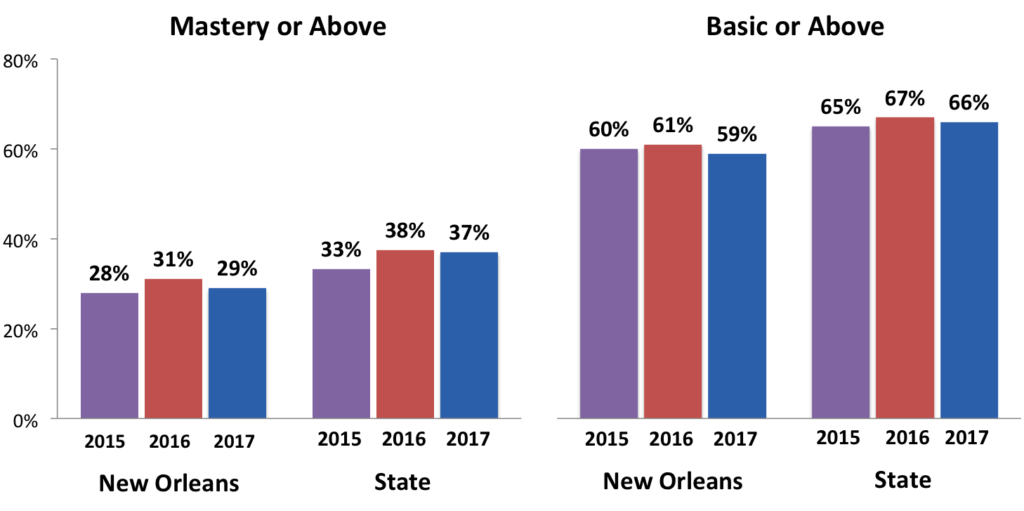
The state has released the results of the 2016-17 LEAP tests for grades 3-8. While a number of New Orleans schools showed improvement, fewer students overall met the new more rigorous Mastery standard, and the city fell in state rankings.

  • New Orleans student performance in English decreased from 35% to 34% Mastery in English (-1) and from 27% to 25% Mastery in math (-2).
  • Statewide, the percent of students scoring Mastery in English improved from 41% to 42% (+1) and dropped in math, from 34% to 32% (-2).
  • New Orleans outperformed the state average for African-American students and English Language Learners.
  • New Orleans’ district rank fell from 47 to 50.

LEAP Performance All Students 2015 to 2017
English and Math Combined

Continue reading

ICYMI: Local Innovation in National Spotlight

In Case You Missed It (ICYMI) … Your mini news clippings

Local Innovation in the National Spotlight

The Carnegie Corporation profiled EdNavigator, a local nonprofit that works with companies to identify and support working parents who need help navigating the school system and advocating for their children.

New Orleans’ own unCommon Construction won a national Teach For America 2017 Social Innovation Award. The nonprofit, which helps students earn credits and scholarships while building houses, will receive $50,000 from TFA to continue developing and expanding their reach.

Researchers estimate that New Orleans children suffer from post-traumatic stress disorder at rates three times the national average. NPR highlighted Crocker College Prep, one of five charter schools in a collective working to become more trauma-informed, and the Christian Science Monitor visited the New Orleans Therapeutic Day Program, a school that gives children with severe trauma and emotional disturbance a safe place to learn.

Continue reading

Latest Cohort Graduation Rates Released

4-Year Cohort Graduation Rates Released

The Orleans Parish School Board and Recovery School District have released the latest 4-year cohort graduation rates. The citywide 4-year graduation rate was 72.1% for the class of 2016,1 a drop of 3.3 percentage points from 2015. Twenty percent of the students who did not graduate in four years remained in school and were enrolled for a fifth year in the fall of 2016.  

Statewide, the graduation rate fell from 77.5% to 77%.

While the graduation rate of 72.1% is a huge improvement from the 54% graduation rate in 2005, these results are still disappointing. We are not graduating 1 in 4 students, even including students who take longer than 4 years to graduate, and the gap to the state average is getting larger, not smaller.

Need to Get Better

The unification of the schools under OPSB represents a new chapter in public education and the opportunity for some new strategies. To improve the graduation rate, we need to:

  • Begin using data to identify drop outs in real time. By October, we can identify students who should be enrolled in school but are not. This information needs to be generated by the central office, as any individual school does not know if a student has dropped out or decided to attend another school. Once we know in a timely fashion which students dropped out, the district can partner with schools and other agencies to find these students and get them re-enrolled.
  • Diversify our high schools. We need more alternative high schools to better address struggling students’ needs. We also need more high schools that offer meaningful career-technical education for interested students.
  • Work to expand access to mental and behavioral health care for students before and during high school. Schools cannot do it alone.
  • Improve our K-8 performance, as discussed below.

Comparing New Orleans to Other Districts

Continue reading