
Fact: Since the state takeover, student improvement has more than doubled!
Educate Now! compared the percent of students Basic or above in math and English on the 4th and 8th grade LEAP and the 10th grade GEE tests for 2000, 2005 and 2010.* (For other grades the state changed the tests, so we can’t compare pre- and post-storm numbers.)
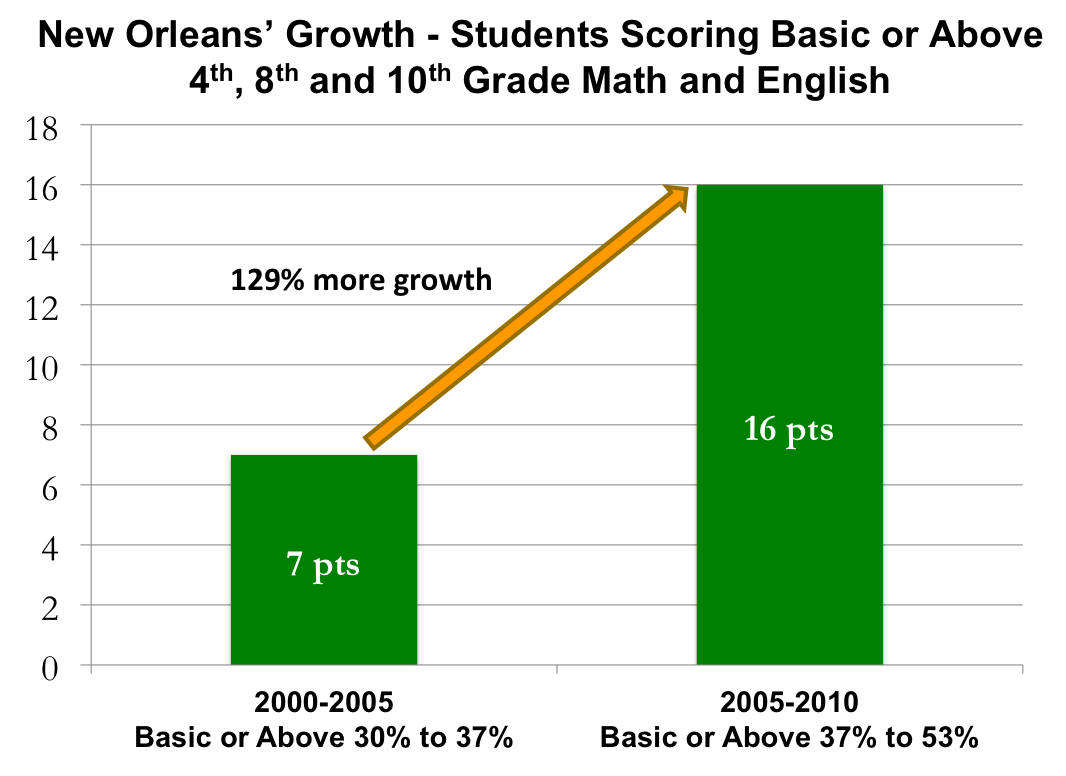
- From 2000 to 2005, the percent of students scoring Basic or above increased from 30% to 37%, a gain of 7 points.
- From 2005 to 2010, the percent of students scoring Basic or above increased from 37% to 53%, a gain of 16 points!
- If we had grown the same number of percentage points in 2005-10 as we did from 2000-05, we would have gone from 37% of students Basic or above to only 44%. Instead, we now have 53% of our students performing at Basic or above.

Our growth improved from 7 points to 16 points, a 129% increase.
Click here to view the numbers behind these calculations. See below for source data.
* The GEE was first issued in 2001, so the 2001 GEE scores are included with LEAP scores under the heading “2000”.
FACT: New Orleans has improved much faster than the state.
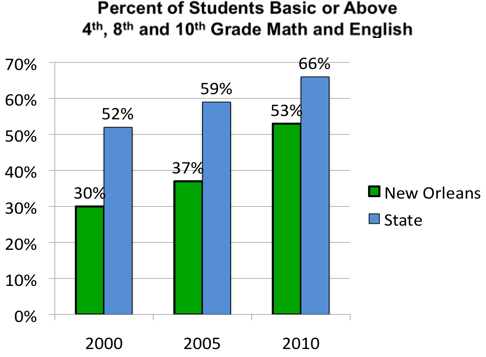
Between 2000 and 2005, both New Orleans and Louisiana showed improvement in student achievement.
Before Katrina, did New Orleans improve more than the state average? NO
Has it improved more than the state average since the levees failed? YES!
Averaging across LEAP and GEE tests (4th, 8th and 10th grade math and English):
- From 2000-2005, New Orleans’ improvement was the same as the state: 7 points.
- From 2005-10, New Orleans grew 9 points more than the state: 16 points versus 7 points.

Click here to view the numbers behind these calculations. See below for source data.
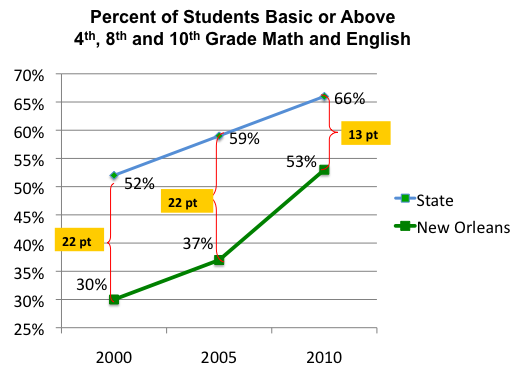
FACT: New Orleans’ impressive growth rate since Katrina has narrowed the performance gap between the city and the state from 22 points to 13 points.
These gains are even more extraordinary if you remember that there was no school year in 2005-06. Students returned to New Orleans having missed months of schools and having suffered immense trauma. Then in 2006-07, there continued to be shortages of teachers, textbooks and buildings. These challenges alone would have made any gains noteworthy. For schools and students to show this amazing rate of improvement is truly exceptional and a cause for celebration.
FACT: Student performance is improving 129% faster than it was before the storm.
FACT: For the first time, New Orleans is improving significantly faster than the state.
FACT: Our goal is for every student to perform on grade level – Basic or above – but clearly we are not there yet.
Click here to view the numbers behind these calculations. See below for source data.
Sources:
Calculations for growth in student performance – New Orleans vs. State
2000 LEAP Results
2001 GEE (The GEE did not begin until 2001, so 2000 data is unavailable.)
2005
2010
LEAP and GEE: State/District Achievement Level Summary Report–Number of Students at Each Achievement Level.
This report was attached to a DOE spring 2010 press release.